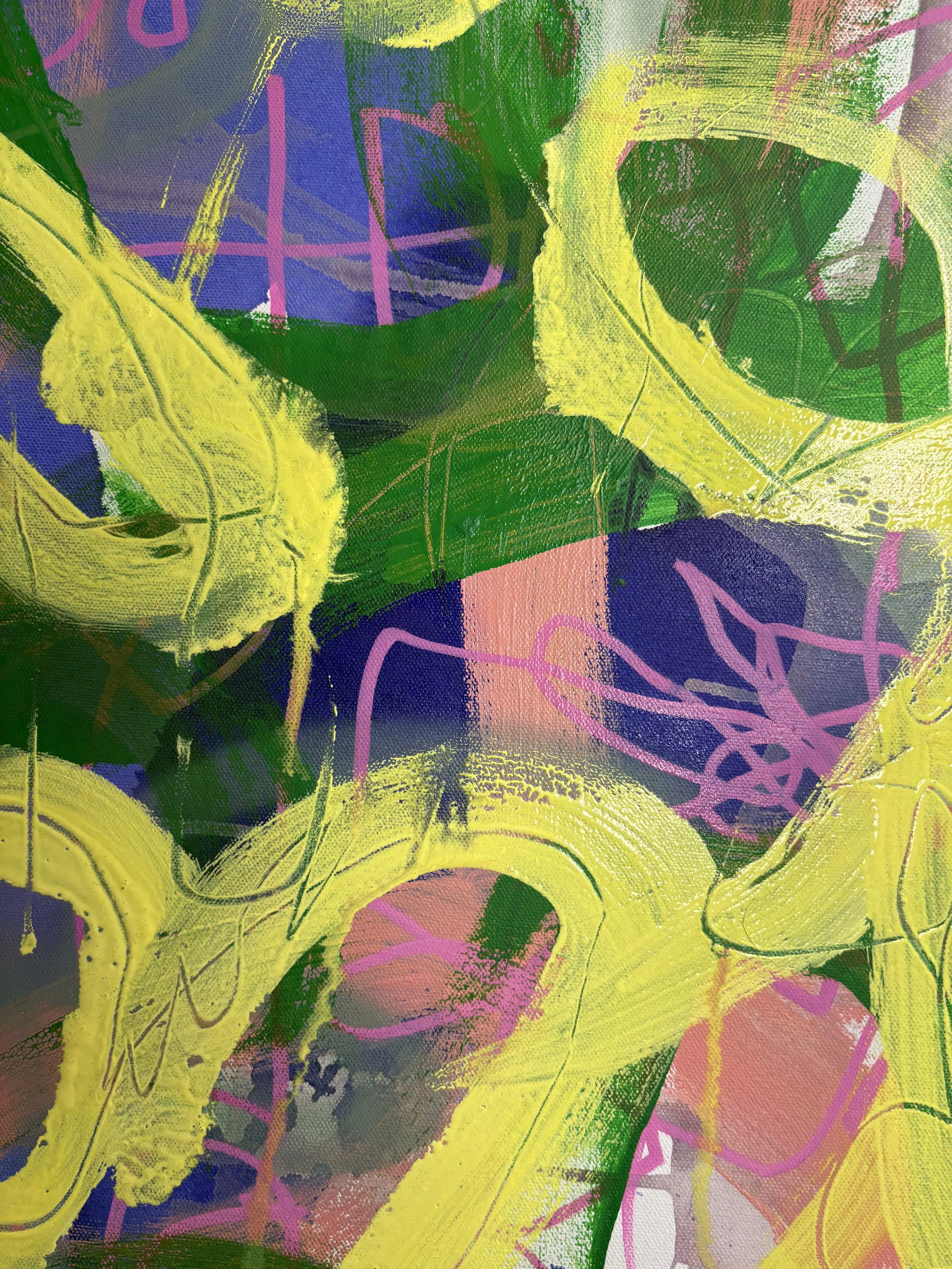
People ask me pretty regularly how I balance teaching and making my own work, and I always feel like I’m supposed to have a much better answer than I do. Some semesters, the answer is basically: poorly? (Haha!) There are absolutely weeks when teaching takes over everything. Classes need prepped, students need feedback, Canvas has decided to become my entire personality, there are meetings and emails and twelve other things that somehow appeared on my calendar, and suddenly I realize I haven’t actually walked into the studio for anything other than looking for scissors in four days.
So yes, finding time can be a problem, but after teaching for as long as I have, I don’t really think about teaching and my studio practice as two completely separate parts of my life anymore. They’ve gotten way too tangled up for that. Something I’m talking about with students ends up following me home into the studio, and something I’m working through in the studio inevitably sneaks its way into a demo, an assignment, or a conversation in class.
I definitely didn’t expect that when I started teaching. I think early on I had this very tidy idea that I would teach during teaching time and then go be an artist during artist time, as though Past Cookie thought life came with clearly labeled storage bins. That lasted about five minutes.
Teaching constantly drags me back through the same things I’ve been thinking about in my own work for years: composition, color, texture, hierarchy, negative space, rhythm, repetition, materials, why one thing works and another absolutely does not. Because I have to explain all of that to somebody else, I can’t always get away with the vague artist answer of, “I dunno, it just looked better over there,” which, for the record, is sometimes a perfectly legitimate studio decision.
I make instinctive choices all the time when I’m working. I move something, cover something up, change a color, or tear something apart because it has annoyed me for two days and I can no longer look at it. I don’t necessarily stop and explain the formal reasoning behind every decision to myself while I’m doing it. Then I walk into class and tell a student that moving one thing half an inch completely changed the hierarchy of their composition, and suddenly I have to explain WHY. It’s mildly rude that teaching makes me justify all the things I happily do on instinct, but it’s also useful.
Teaching forces me to put language around things I might otherwise leave entirely intuitive, and every time I do that, I end up noticing something about my own work too. I’ll be explaining negative space or visual tension or why an element needs more room around it, and somewhere in the back of my brain I’m thinking, “Oh. That thing sitting on my studio table? Yeah, I’m doing exactly what I just told them not to do.”
Iteration gets me constantly too. I tell students all the time to make more versions, not to fall in love with the first solution, to move things around, try the version they think won’t work, save a copy and wreck it, and make three more because the one they currently think is brilliant may look considerably less brilliant tomorrow morning. Then I go back to my own work and immediately want Version Two to be THE VERSION. Apparently I also need the assignment.
Students are also really good at disrupting habits I don’t even realize I have. Give twenty people the same basic problem and somebody will approach it in a way that would never have occurred to me. They’ll combine materials I mentally keep in completely different categories, layer something in a way I initially think is bonkers, or ignore some invisible rule I’ve accumulated after decades of making things.
Sometimes it’s a disaster, obviously. We’re not pretending every experimental decision is secretly genius. Haha. But every once in a while I’ll look at something a student has done and think, “Well sh*t. Why DON’T I do that?” (which reminds me a bit of the Jealous Curator’s old motto of “damn i wish i though of that”)
I’ve especially noticed this with the way students move between digital and physical processes. I came up through a time when those things felt much more separated. You were making a print, or you were working digitally, or you were making a collage. Meanwhile, students will photograph something, drag it into Photoshop, print it, draw over it, scan it again, tear it apart, photograph THAT, and keep going without apparently needing to hold a committee meeting about what medium it belongs to.
I love seeing that because it reminds me that I can get a little too precious about process sometimes. Years of experience are great, but years of experience also mean years of developing habits, and not every habit deserves lifelong tenure.
The funny thing is that teaching beginners can have the same effect. I spend a lot of time talking about basic composition, value, color relationships, space, proportion, and all the other foundational stuff we sometimes like to imagine we eventually graduate from. We absolutely do not. If I’m looking at fifty student compositions in a week and talking about why one feels cramped or why another suddenly starts working when a shape moves slightly to the left, I start seeing those same relationships much more clearly when I get back to my own work. It’s like having my eyes recalibrated over and over again.
My studio practice turns around and does the same thing to my teaching. I don’t want to stand in front of students pretending that making art is this clean little sequence where Idea A becomes Sketch B and then, through the magic of Being An Artist, Finished Work C appears, because that is very much not how I work.
When I was working on my Echoes of Eve collage series, I brought pieces into class while they were still very much in the “what the hell am I doing with this section?” stage. There were taped fragments, awkward bits, things I ended up ripping apart, things that moved around repeatedly, and compositions I was absolutely not sure about yet. I like students seeing that part because I think there can be this assumption, especially when you’re new to making art, that eventually you become experienced enough that uncertainty disappears.
Apparently one day you receive your Official Artist Certificate and from that point forward every composition works, your ideas arrive fully formed, and you never spend twenty minutes moving the same scrap of paper back and forth. Alas, sorry to report that this does not happen.
I still get stuck and I still make ugly things. I still think something is done and realize two days (or years) later that it absolutely is not. I still second-guess decisions, abandon ideas, and occasionally make something so terrible that its main contribution to my artistic development is going directly into the trash. I think students should see some of that because it’s real, and it also keeps me from teaching art as though I have somehow reached the end of the process myself.
I’m still working through all of this too. I may have more experience and a much larger collection of art supplies than most of them, but I’m still experimenting, changing my mind, getting annoyed, figuring things out, and occasionally wondering why I decided making art was a reasonable way to spend my life.
The overlap sneaks into assignments all the time too. If I’ve become obsessed with layering, students are probably about to encounter layering somewhere. If I’m playing with limited palettes, image transfers, repetition, collage, book structures, or some other process, there is a decent chance I’m going to start thinking about what could happen if I built an assignment around it. Sometimes teaching the assignment then sends me right back into the studio with another idea, so at this point the whole thing is basically one ongoing loop.
Of course, none of this magically fixes the scheduling problem. There are still parts of the semester when I have very little studio energy left after teaching, and I’m actually trying to get better about protecting time for my own work instead of assuming I’ll magically find it once everything else is done. Everything else is never done. We know this.
Even when I’m not physically making as much as I’d like, teaching keeps me thinking about making. I might spend a morning talking about texture with students and then catch myself thinking about some weird surface treatment later that night. Or I’ll see a student solve a problem in a way I hadn’t considered and suddenly I want to go try something completely unrelated that came out of that conversation. Then I’ll go through a stretch where I’m making a lot myself, and THAT starts pouring into class.
So I don’t really have a clean answer anymore when somebody asks how I balance the two. Some weeks I don’t. Mostly they just keep getting mixed together, which at this point feels much more accurate to how my life actually works anyway.
Teaching makes me examine what I think I know, while making keeps me connected to what it actually feels like to be working through a problem when there isn’t an answer sitting in the back of the book. After all these years, most of the interesting stuff seems to happen somewhere in that overlap anyway.
