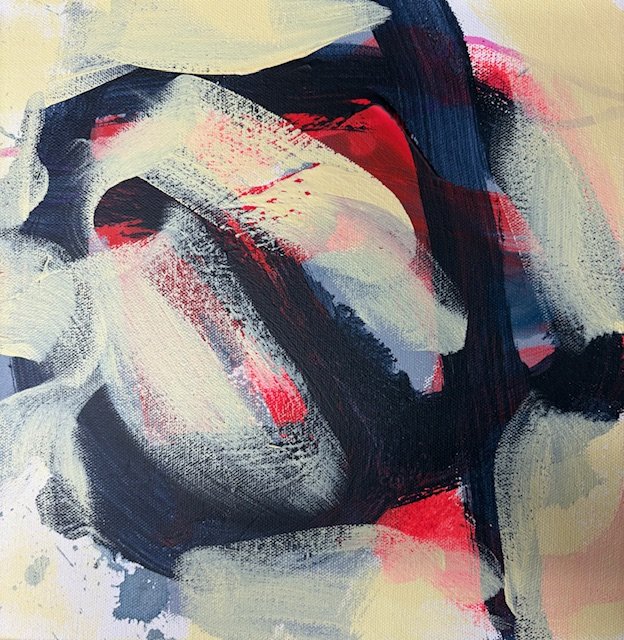
Texture is one of those things I keep coming back to in my work, whether I mean to or not. It shows up in collage, painting, printmaking, digital work…pretty much everywhere. I don’t really think of it as something I add at the end to make a surface more interesting. Most of the time, it is part of how I start building the piece in the first place.
When I first got more serious about collage, I thought I was mostly interested in composition, color, shape, and all the usual suspects. Over time I realized I was also making a LOT of decisions based on how the materials felt next to each other. Smooth paper against rough paper, torn edges next to clean cuts, matte surfaces beside glossy ones. I started saving scraps because I liked the paper itself, even if I had absolutely no idea what I was going to do with it. Which, to be fair, explains a large percentage of the drawers in my studio.
I like surfaces that show evidence of being worked on. If I scrape paint back, tear through a layer, sand something down, or glue something in a way that leaves a little wrinkle or buckle, I don’t necessarily want to erase all of that afterward. I like being able to see some of the history of the piece.
That’s probably also why perfectly smooth surfaces have never been especially appealing to me. I want to see where something changed direction, where an earlier layer is still hanging around, or where the material did something I wasn’t entirely expecting. Most of my work gets built through a lot of adjusting, covering, ripping apart, moving things, and trying again, so it makes sense that I’m drawn to surfaces that don’t pretend none of that happened.
Collage is especially good for this because the materials are constantly misbehaving in one way or another. Glue wrinkles things, paper buckles, edges lift, and something that looked perfectly flat five minutes ago has apparently decided it would like a more dimensional career. I used to fight that stuff more. Now I’m much more likely to look at it and think, “okay, can I use this?”
Painting works a little differently, but I’m doing the same thing there. I like visible brushstrokes, scraped areas, transparent paint sitting next to something thicker, and layers that don’t completely disappear under whatever came next. I’ll build something up and then sand half of it back down because apparently creating extra work for myself is part of the process. Haha.
Printmaking probably made me even more obsessed with surface. Collagraph in particular is basically texture becoming the image. You build the plate out of materials and surfaces, ink the whole weird thing, run it through the press, and see what actually transfers. I love that the physical qualities of the plate aren’t separate from the image. They ARE the image.
And even when I’m working digitally, I still find myself dragging physical texture back in. I scan paper, paint, ink marks, scratches, old prints, whatever looks interesting, because I usually don’t want the work to feel completely smooth or detached from anything handmade.
That’s a big reason I don’t separate my digital and analog work very much anymore. They bounce back and forth constantly. I might make something by hand, scan it, manipulate it digitally, print it again, tear it apart, and put it back into something physical. At some point asking which category it belongs to becomes kind of useless.
Texture comes up in my teaching a lot too because students can get so focused on the image or the concept that the material itself becomes almost invisible to them. Change the paper, leave an edge exposed, layer something unexpected, let an earlier mark stay visible, and suddenly the piece has a completely different feel.
I’m also forever telling students not to immediately “fix” every weird thing that happens. Sometimes the wrinkle, scrape, rough edge, or bit they thought was a mistake ends up being the part that gives the work some life. I apparently need this reminder too because my first instinct can still be to clean something up before I’ve decided whether it actually needs cleaning up.
I think that’s really why texture keeps showing up in everything I do. It makes the process visible. It gives me something to respond to while I’m working, and it keeps the materials from feeling completely passive. I like that the surface can carry some evidence of what happened while the piece was becoming whatever it eventually became. Basically, I want to see that somebody touched the dang thing.
